We are in a crisis in the evolution of human society. It’s unique to both human and geologic history. It has never happened before and it can’t possibly happen again. Albert Bates, author of The Financial Collapse Survival Guide and Cookbook, brings you along on his personal journey.
"The time to prepare is not when your house is burning"
A 1981 classic B-movie (available on Prime and YouTube) was Quest for Fire. Plot:
A Cro-Magnon clan led by Ron Perlman depends on a carefully tended
source of fire, stored in a lamp, which accidentally extinguishes,
throwing the clan into existential panic. Lacking the knowledge to
kindle a new fire, they send three tribesmen to search for another
source and bring it home. The hunters encounter a Homo sapiens woman,
Rae Dawn Chong, who teaches them not only how to make fire but also the
Kama Sutra, winning her a Genie for best actress. 20th Century Fox
pitched it as a sort of “2001: A Space Odyssey” minus the apes and
spaceships. Even without Kubrick, Quest won a
dozen awards, including an Oscar and a BAFTA for best makeup, but
perhaps most remarkable was the absence of dialogue. The whole film was
just grunts.
Fast forward a half dozen ice ages and we no longer have a problem finding fire. Lately, it’s been finding us.
Fire
is one of the features of 21st Century that will only accelerate as the
world warms. No amount of A.I or MAGA will change that. What can be
changed is our response when it arrives, as it will.
After a
string of disastrous fire seasons, Ontario and British Columbia updated
their fire prevention, suppression, and risk reduction laws. FireSmart
Canada set out mitigation practices for homes and neighborhoods (e.g.,
clearing combustible materials near structures, vegetation management,
etc.). Oregon went further, mapping properties that required compliance
with strict new codes, with fines for scofflaws, but public uproar
forced lawmakers to repeal the new rules a year later. California
legislators took note and slowed down their planned upgrades. That
prompted fire-smitten cities like Berkeley, San Diego and Los Angeles to
enact their own.
Berkeley’s law declares a “Zone Zero,” a
permaculture term, around every residence, starting this month. It
prohibits flammable material within the closest five feet of any
structure. For many homeowners, that means removing wooden fences and
rose bushes.
In Los Angeles, the new rules meant cutting many
trees, including some very historic and valued ones, and there was
pushback. At what point are the benefits of urban forest—cooling,
hydrating, giving habitat to wildlife and pollinators—outweighed by the
danger of urban wildfire? Cowed, many fire districts retreated to
policies of education over enforcement.
There is a more
significant interface than urban forest and wildfire that is coming into
play. As Onandagan firekeeper Oren Lyons put it, “Nature does not have
mercy. None. Nature has only laws.” Angelinos and Oregonians are trying
to have it both ways—to cut a deal. They still believe the American
Way—consumerism über alles—is non-negotiable, but are grudgingly willing
to negotiate. Maybe we’ll cut down some trees and sacrifice our rose
bushes, okay? The other side does not negotiate.
The rules are not complicated. Sunlight
falling on the planet is kept as heat only in balance with reflection
of light back to space by icecaps, and other shiny things, and by
photosynthesis—absorption of heat and production of water vapor by
forest cover, the downstream exhalations of animals such as ourselves,
and the occasional volcano. Skew that balance at your peril.
Introducing
a 300-million-year stockpile of fossil sunlight (coal, oil and gas)
into the atmosphere within a scant few human generations tipped the
balance.
Wally Broeker, whom I interviewed for Climate in Crisis in 1988, used to say that climate was “an angry beast” that humans were poking with a stick. Jim Hansen, in his newsletter this week, recalled
that Wally occasionally got in trouble because he liked to speculate,
which is the antithesis of scientific rigor, or “reticence” as Hansen calls it. Broeker
was among the first to predict the slowing of the AMOC, which
transports heat from the equator to the Canadian Maritimes and Northern
Europe. We are now seeing that slowing. It bodes ill for the Northern
countries, especially Iceland and Greenland.
There were
early climate heroes—Mike Flanigan, Stefan Doerr, and John
Abatzoglou—who correctly predicted that higher temperatures and drier
fuels would increase ignition probability, spread, and intensity of
wildfire, speculating that by the 2000s–2010s, climate‑driven fire risk
would extend almost everywhere. That news was included in the climate
emergency briefing Lyndon Johnson received in 1965.
The underlying problem,
for Johnson as much as anyone, was our collective addiction. As Hansen
put it in his draft opening chapter of Sophie’s Choice, “fossil fuels
are the source of rising living standards.” He goes on to say that only
after they are proven to contribute to climate change and the “most
powerful nations are led by governments willing to follow the science”
will we begin to reduce our dependence. Sorry, Jim. I disagree.
First,
I am sure Hansen would agree that greenhouse gases from fossil fuels
are already proven to be the primary cause of the climate crisis
(land-use change from agriculture and urbanization, jet travel, and
whaling are among other, lesser causes). Second, if all the world’s
governments were social democracies like Denmark, perhaps they would be
willing to follow the science, but they are not and even Denmark doesn’t
do that.
I suspect Hansen subscribes to the “rational actor”
theory of governance and economics. The framers of the US Constitution
seem to have had a blind spot there as well. Personally, I think the
addiction model better describes our dilemma. Donald Trump, for
instance, is addicted to rewards. Apparently, he was starved for praise
as a child. Now no amount of wealth or fame is enough for him. He is
addicted to the acquisition process.
The homeowners declining to
cut back their roses are similarly addicted. They have a normalcy bias.
If they just ignore the wildfire threat, they can keep their roses and
simply refuse to acknowledge that pretty flowers may threaten their
home, all their belongings, and even their lives.
This is one
reason I like biochar so much. It cuts through the dopamine cravings
like a superspeedy running back finding a crease.
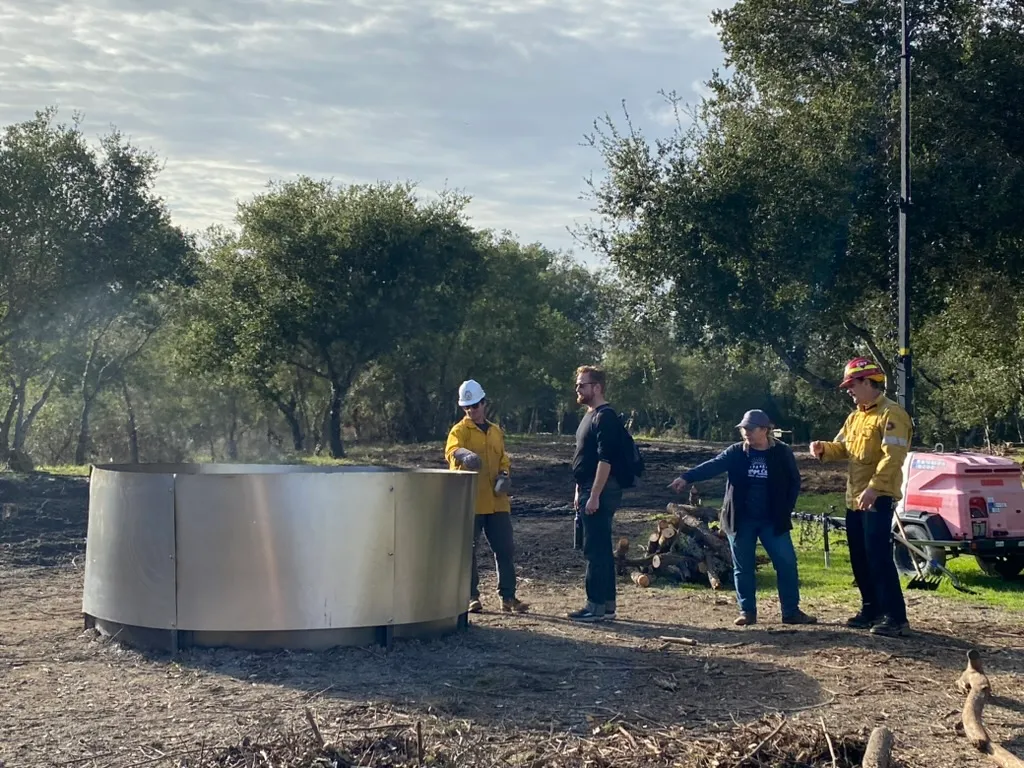
CalFire has been
pioneering the use of mobile biochar kilns to mitigate fire risk for
several years. In 2024, I visited a site in the Berkeley Hills where a
forest service contract with Biochar on Site
[https://donorbox.org/biochar-on-site] was demonstrating how to thin
highly flammable eucalyptus in a State Forest by turning it into
biochar. Broadcast back onto the forest floor, the biochar worked like a
sponge when it rained, arresting surface erosion, percolating water
towards tree roots, and storing excess for a later season when the trees
would need to endure the drying heat of the Santa Ana winds.
It
would be nice to imagine thousands of small backyard biochar kilns—like
the cutesy Charbeque—used to thin and water the urban forests of
California cities. County burning rules prohibit those in many places.
Even the air curtain incinerators and flame cap kilns that CalFire uses
are outlawed—that’s considered open burning.
Recently biochar engineer emeritus Tom Miles calculated how much biomass might be generated by the new Zone Zero rules in Berkeley:
An average building footprint of 2400 ft2 on a 6550 ft2 lot
An average building perimeter of 192 ft.
A 5-foot strip of 960 ft2 per home or 22 acres for 1,000 homes.
Reduce the area 30% for walkways, patios, steps, driveways, and other noncombustible surfaces—15.4 acres
Each home would be clearing 60-240 lb dry biomass.
The
fuel load would range from a low of about 2 dry tons/acre (light mulch,
sparse ground cover) to a high of 8 dry tons per acre (dense shrubs,
hedges, or heavily mulched area) with a moderate load of 5 dry tons per
acre (continuous ornamental shrubs or thicker mulch).
The total biomass removed for 1000 homes would range from 52 to 205 green tons or 31 to 123 dry tons.
Tom
went on to speculate about what might be if the county decided to
support biochar production the same way it provides garbage pickup or
trash recycling.
The average mobile chipper fills a truck with 6
tons of chips in an hour or two, depending on the drive time between
houses and the drag distance. Zone Zero clearing would provide from 7 to
26 truckloads. At 30% yield (some kilns are more efficient) that
produces 9 to 37 tons of biochar.
Tom says a Tigercat mobile
carbonizer, which is probably the least efficient of the mobile kilns
although CalFire already owns a few of them, could process this material
in one or two days if it were hauled in bulk to a central site. The
finished biochar, which already has a climate benefit built in by virtue
of keeping greenhouse gases locked away for millennia, could be
distributed back to homeowners or used on public lands and city green
spaces to nurture nature and build drought—and fire—resistance.
Win Win.
Thinning the Tilden Regional Park with CalFire, Kelpie Wilson, and the portable smokeless Ring of Fire biochar kiln. Photo by author, 2024.
This week, I have an announcement for
subscribers and other readers regarding this theme of climate
preparedness and carbon budget rebalancing. The group responsible for
CalFire’s interest in biochar—inventors and distributors of their own
mobile kilns, and convenor of workshops for homeowners and
authorities—is Biochar-On-Site. Global
Village Institute is pleased to announce that we have agreed to sponsor
B.O.S.’s tax-deductible fundraising campaign going forward. If you
would like to pledge $8 per month (about the cost of one Peppermint
Mocha or Frappuccino at Starbucks), you can help municipalities like
Portland and Berkeley produce biochar from their urban waste and from
protected forested areas. That Frappuccino for your friends is now
tax-deductible.
The
rules Mother Nature imposes are not complicated or onerous. We still
get to live happy lives. We just can’t keep breaking them and imagine we
are getting away with it.
Fire is a powerful reminder.
Meanwhile, let’s end these wars. We support peace in the West Bank and Gaza and
the efforts to cease the war in Ukraine immediately. Global Village
Institute’s Peace Thru Permaculture initiative has sponsored the Green
Kibbutz network in Israel and the Marda Permaculture Farm in the West
Bank for over 30 years. It will continue to do so with your assistance.
We aid Ukrainian families seeking refuge in ecovillages and permaculture
farms along the Green Road and work to heal collective trauma
everywhere through the Pocket Project. You can read about it on the
Global Village Institute website (GVIx.org). I appreciate your support.
And speaking of resettling refugees, did you know? A study by Poland’s National Development Bank found that the influx of Ukrainians added between 0.5% and 2.5% to GDP growth and paid more in taxes than they received in benefits.
Could
you help me get my blog posted every week? All Patreon donations and
Blogger, Substack and Medium subscriptions are needed and welcomed. You
are how we make this happen. Your contributions can be made to Global
Village Institute, a tax-deductible 501(c)(3) charity. PowerUp! Donors
on Patreon get an autographed book off each first press run. Please help
if you can.
#RestorationGeneration.
When
humans are locked in a cage, the Earth continues to be beautiful.
Therefore, the lesson for us is that human beings are not necessary. The
air, soil, sky and water are still beautiful without you. So, when you
step out of the cage, please remember that you are guests of the Earth,
not its hosts.
We have a complete solution. We
can restore whales to the ocean and bison to the plains. We can recover
all the tremendous old-growth forests. We possess the knowledge and
tools to rebuild savannah and wetland ecosystems. Coral reefs rebuilt
with biorock build beaches faster than the seas are rising. It is not
too late. All of these great works of nature are recoverable. We can
have a human population sized to harmonize, not destabilize. We can have
an atmosphere that heats and cools just the right amount, is easy on
our lungs and sweet to our nostrils with the scent of ten thousand
flowers. All of that beckons. All of that is within reach.
And now we have our own swag store at Red Bubble. Swing on in for the latest wearables and chachkas....
Thanks for reading The Great Change! This post is public so feel free to share it.
 This week, I have an announcement for
subscribers and other readers regarding this theme of climate
preparedness and carbon budget rebalancing. The group responsible for
CalFire’s interest in biochar—inventors and distributors of their own
mobile kilns, and convenor of workshops for homeowners and
authorities—is Biochar-On-Site. Global
Village Institute is pleased to announce that we have agreed to sponsor
B.O.S.’s tax-deductible fundraising campaign going forward. If you
would like to pledge $8 per month (about the cost of one Peppermint
Mocha or Frappuccino at Starbucks), you can help municipalities like
Portland and Berkeley produce biochar from their urban waste and from
protected forested areas. That Frappuccino for your friends is now
tax-deductible.
This week, I have an announcement for
subscribers and other readers regarding this theme of climate
preparedness and carbon budget rebalancing. The group responsible for
CalFire’s interest in biochar—inventors and distributors of their own
mobile kilns, and convenor of workshops for homeowners and
authorities—is Biochar-On-Site. Global
Village Institute is pleased to announce that we have agreed to sponsor
B.O.S.’s tax-deductible fundraising campaign going forward. If you
would like to pledge $8 per month (about the cost of one Peppermint
Mocha or Frappuccino at Starbucks), you can help municipalities like
Portland and Berkeley produce biochar from their urban waste and from
protected forested areas. That Frappuccino for your friends is now
tax-deductible.





Comments