Lootocracy: Follow the Money
After acquiring Twitter in 2022, Elon Musk rebranded it as X and reversed or weakened many of the platform’s previous hate‑speech policies. He is now in legal trouble in Europe for violating laws that mandate those policies, such as laws against denying the Holocaust. Musk usually did not post homophobic, white nationalist, or antisemitic rhetoric himself, but rather made his mark by retweeting, although, as yet, no animations parodying The Lion King. He fired large parts of Twitter’s trust‑and‑safety staff, reinstated suspended far‑right accounts, relaxed enforcement on homophobic and transphobic rhetoric, and even removed policy language that explicitly protected transgender users from harassment. He also scrapped the previous verification model and turned “blue check” status into a paid subscription, then began sharing advertising revenue with high‑engagement accounts, many of them right‑leaning commentators, incentivizing the most provocative content.

Elon Musk is the world’s wealthiest individual. His current pay package with the companies he founded will soon make him the world’s first trillionaire.
He lost money by purchasing Twitter and then wrecking it, but financial gain was not his objective for buying it. Influence was. A policy analysis of X under Musk, conducted at NYU’s Stern School of Business, found that dismantling moderation teams and Musk’s “free speech” framing of his policies facilitated the circulation of election lies with minimal friction. Musk’s choices in direct political spending also tilted toward candidates who skillfully wielded disinformation and favored a more permissive environment for misinformation.
Bezos did none of that at the Post. He merely sucked up to Trump, donating to his PAC, paying for the inauguration, the White House makeover, the Kennedy Center, and the Melania vanity film. He chose not to Foxify WAPO, but when push came to shove, he shoved it overboard.
In 2024, X became an epicenter of U.S. election misinformation and deception, according to a report by the Center for Countering Digital Hate. Deutsche Welle reported Musk reposted or endorsed conspiracy narratives about Democrats supposedly importing “illegal” voters and other debunked allegations—posts that instantly drew tens of millions of views. Musk’s election‑misinformation posts received over 200 times the views of fact‑checking messages from state and local election officials on X, a skew that was not by good fortune, but algorithmically driven by Musk.
To put Dear Leader back into the White House, Musk used $75 million to launch America PAC and transformed X into a more clearly right‑leaning, pro‑Trump environment, with Republicans increasingly positive about its democratic impact and Democrats increasingly negative and fleeing to other platforms. Musk continued to pour tens of millions into the Trump campaign—on door-to-door canvassing, digital ads, and a controversial petition-signing incentive program offering $47 payments (and up to $1 million lotteries) to registered voters who signed a pro-First and Second Amendment petition that also collected voter data for targeting. Later filings show Musk’s total contributions to America PAC exceeded $118 million by mid-October and reached around $288 million by November 25, making Musk (formerly an illegal immigrant) the historically largest political donor—besting billionaire Timothy Mellon’s $150 million to MAGA and $25 million for Robert F. Kennedy Jr.’s presidential bid, and Miriam Adelson’s $150 million to push Dear Leader into fully endorsing the Gaza genocide and to sanction any World Criminal Court judges attempting to arrest it.

Battle of the Billionaires
Jeff Bezos is a Musk of a different stripe. Neither blue nor red. Before Musk came along, he was the world’s richest man and may yet become the world’s second trillionaire. Like Musk, he has his own pleasure-cruising rocket ships. Like Musk, he spent some of his personal wealth to buy a megaphone, in this case, The Washington Post, for $250 million in 2013. He was praised by journalism watchdogs for allowing free expression to reign and not tampering with editorial content. He was like the owner of a sports franchise. He did not confuse his role with that of the managers or coaches. Then last week, he laid off 100 high-level employees—reporters and editors—and admitted defeat.
Jeff Bezos’s wealth growth amounts to approximately $79 million/day, or $551 million per week—more than half a billion dollars. Amazon reported $213 billion in revenue in its last fiscal quarter, up 14% from a year earlier. By contrast, even with ad revenues of $174 million, the Post is losing $100 million per year. Bezos income in one week is enough to cover the Post’s losses for at least 5 years, and even expand its coverage into domains that have proven successful for The New York Times and The Guardian. So why the retreat?
Like Musk, Bezos’ businesses rely on government contracts. That’s the source of both of their fortunes. Musk needs NASA to support SpaceX. He needs the Pentagon to support Starlink. He wants to sell armored cybertrucks to the Marine Corps. Musk would like the Boring Company to build the commuter tunnels under the Hudson.

Bezos sells Amazon Web Services to government agencies. AWS holds $329 million+ in federal contracts across administrations, including Pentagon and ICE cloud deals. AWS serves over 11,000 agencies globally but has hefty US federal contracts and also needs State Department approval for many of its overseas services. Executive orders on tariffs, taxes, antitrust, labor, AI, and data privacy could decimate Amazon’s e-commerce. While e-commerce earnings rose 14% last year, AWS’s rose 24%. From a bent knee, Bezos drove an estoque de matar into the heart of the Post.
Instead of rescuing The Washington Post, he will pump $200 billion into AI, chips, robotics, and low-earth orbit satellites this year. “I hope it’s not a death spiral, but I worry that it might be,” said former Post executive editor Marty Baron, who won 11 Pulitzer prizes.
Cash for Pardons

Over half of Dear Leader’s second-term pardons went to white-collar criminals (money laundering, fraud), with 50% of those bag drops laundered through his 2024–2025 PACs. Zhao and Milton were also repaid many times over by Trump/Musk/Sacks’s pro-crypto deregulation agenda. That pay-for-pardons grift is now paying, along with Bezos and the other favor-curriers, for the East Wing and Kennedy Center makeovers, reseeding the Ellipse with golf course turf, and erecting a giant gold colossus of Dear Leader, fist upraised, at the Doral Resort.
Luke Kemp, author of Goliath’s Curse: The History and Future of Societal Collapse (2025), coined a word for this: “Lootocracy.” The book analyses 324 case studies of regimes and empires that fell apart. Corruption ranks high among the causes (after climate change).
How did we get here?
Arguably, Donald J. Trump is the first politician to take full advantage of screen hypnosis. He was born 5 days before Joe Louis’s 8th-round knockout of Billy Conn for the heavyweight title, which might be an unremarkable coincidence but for the fact that the fight was the first ever advertiser-backed broadcast on national television. Their brainwormy jingle likely generated more revenue for Gillette razors than the $2 million ringside gate paid Louis.
The Louis title fight did something even more brainwormy, possibly existential, to Homo sapiens. It birthed the demonic twins of screen time and eyeball-centric advertising.
Television penetration into U.S. households increased from 5% at the time of the Louis-Conn fight to 87% for the Nixon-Kennedy showdown in 1960. Europe and Japan followed apace, with TV penetration reaching 90% across households in all overdeveloped nations by the 1970s.
Negative effects like obesity, aggression, and cognitive delays began being published in science journals in the 1960s. Parents started to worry about children’s “boob tube” fixation displacing play and study. In 1961, Senate hearings linked tube time to the rise in juvenile crime. In 1963, Bandura’s Bobo doll experiments demonstrated that the causal connection between TV and violence in society, notably among children, was mediated by genetically ordained brain maturation—observation, imitation, and modelling.
According to a peer-reviewed study by Muppalla et al, published in 2023:
Why have math and reading skills declined in US children, especially young boys, in recent years? Numerous cohort studies have found a long-lasting association between early screen media exposure and cognitive abilities, with each one-hour increase in TV exposure at two years of age corresponding to a 7% decrease in class participation and a 6% decrease in fourth-grade math proficiency. Even mild internet use is associated with epigenetic (DNA) alterations in key neurotransmitter genes, including the oxytocin receptor, dopamine transporter, and serotonin transporter, among young university students.
Returning to Donald Trump, a latchkey TV child, the early years of childhood are crucial for acquiring various aspects of language, including vocabulary and phonology, as well as motor skills, cognitive development, and social development. Muppalla reported:
Early and persistent exposure to violent content raises the chance of engaging in antisocial behavior. Psychoneurological effects of addictive screen time use include a decrease in social coping skills and the development of craving behaviors resembling substance dependence. Structural changes in the brain related to cognitive control and emotional regulation have been observed….
Recognizing how essential computer literacy was for economic success, schools began introducing children to “computer labs” in the 1960s, personal computers in the 1990s, and even providing free devices like Chromebooks and iPads, before, during and after the 2020 pandemic. There were more than half a billion smartphones in India by 2020, and a growing number of those were held by children—children whose opinions of the world were being shaped by social media; social media driven by algorithms designed by advertisers to acquire eyeballs; eyeballs often acquired through the lower brainstem portals of fright, tribe, hunger, and sex.
I doubt Dear Leader read, as I did as a teen, Isaac Asimov’s Foundation and Empire trilogy (1945), but there was an interesting plotline that helps explain Trump’s special power of political influence.

The Mule—a telepathic mutant conqueror—wields the Visi-Sonor, a multi-keyed instrument that generates holographic visuals, immersive music, and emotional manipulation to mesmerize and brainwash mass audiences, sowing despair or loyalty without overt force. In the Visi-Sonor addiction, Asimov foresaw today’s screen-time hypnosis, in which ad algorithms and immersive digital media subtly shape emotions, attention, and behavior at a societal scale, often bypassing rational resistance or constitutional frameworks.
The tech bros and broligarchs get this. They get it much better than Donald, who was merely a TV vassal. Watching Musk and Bezos, they have now learned that for a few hundred million—table stakes to a trillionaire—they could purchase (a) the winning candidate; (b) a pivotal social media empire; and (c) national elections that hold the fate of the world.
This inquiry will continue next week with Screen Hypnosis Part II: Canceling the Subscription
References
Annunzi, E., Cannito, L., Bellia, F. et al. Mild internet use is associated with epigenetic alterations of key neurotransmission genes in salivary DNA of young university students. Sci Rep 13, 22192 (2023). https://doi.org/10.1038/s41598-023-49492-5
Bandura, A.; Ross, D.; Ross, S. A. (1961). "Transmission of aggression through the imitation of aggressive models". Journal of Abnormal and Social Psychology. 63 (3): 575–582. doi:10.1037/h0045925
Muppalla SK, Vuppalapati S, Reddy Pulliahgaru A, Sreenivasulu H. Effects of Excessive Screen Time on Child Development: An Updated Review and Strategies for Management. Cureus. 2023 Jun 18;15(6):e40608. doi: 10.7759/cureus.40608.


Global Village Institute is pleased to announce that we have agreed to sponsor Biochar-On-Site. If you would like to pledge $8 per month (about the cost of one Peppermint Mocha or Frappuccino at Starbucks), you will make biochar from crop and forestry waste to protect forested areas and build healthy, water-retaining soil. The Frappuccino you buy for your friends is now tax-deductible.
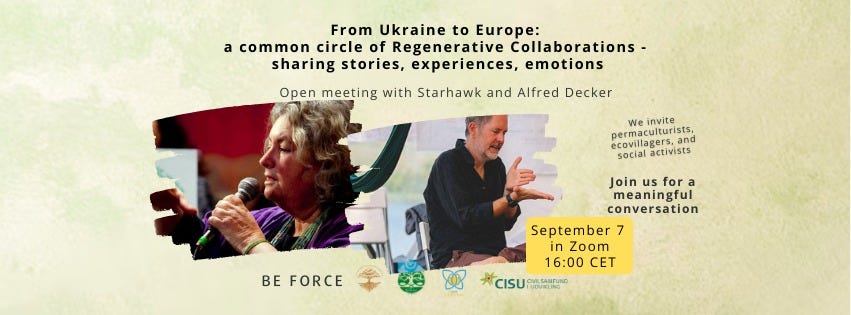
Meanwhile, let’s end these wars. We support peace in the West Bank and Gaza and the efforts to end the war in Ukraine immediately. Global Village Institute’s Peace Thru Permaculture initiative has sponsored the Green Kibbutz network in Israel and the Marda Permaculture Farm in the West Bank for over 30 years. It will continue to do so with your assistance. We support Ukrainian families seeking refuge in ecovillages and permaculture farms along the Green Road, and we work to heal collective trauma worldwide through the Pocket Project. You can read about it on the Global Village Institute website (GVIx.org). I appreciate your support.

And speaking of resettling refugees, did you know? A study by Poland’s National Development Bank found that the influx of Ukrainians added between 0.5% and 2.5% to GDP growth and paid more in taxes than they received in benefits.
Could you help me get my blog posted every week? All Patreon donations and subscriptions to Blogger, Substack, and Medium are welcome. You are how we make this happen. Your contributions can be made to Global Village Institute, a tax-deductible 501(c)(3) charity. PowerUp! Donors on Patreon get an autographed book off each first press run. Please help if you can.
#RestorationGeneration.

We have a complete solution. We can restore whales to the ocean and bison to the plains. We can recover all the tremendous old-growth forests. We possess the knowledge and tools to rebuild savannah and wetland ecosystems. Coral reefs rebuilt with biorock build beaches faster than the seas are rising. It is not too late. All of these great works of nature are recoverable. We can have a human population sized to harmonize rather than destabilize. We can have an atmosphere that heats and cools just the right amount, is easy on our lungs and sweet to our nostrils with the scent of ten thousand flowers. All of that beckons. All of that is within reach.
 |



Comments