My not very palatable theory of change

You say you got a real solution
Well, you know
We’d all love to see the plan
—The Beatles, “Revolution“
In a talk at the Harvard Radcliffe Institute on February 14, conservative columnist David Brooks laid out a theory of change.
I don’t identify as a political conservative the way Brooks does, but I resonate strongly with his point about the danger of abrupt change. In a brief to the United States Supreme Court in 1982, I also quoted Burke, who argued that:
Speaking of the society into which each of us is born, Burke argued that it is always wrong to “hack that aged parent in pieces.”
Society is indeed a contract. . . . It is a partnership in all science; a partnership in all art; a partnership in every virtue, and in all perfection. As the ends of such a partnership cannot be obtained except by many generations, it becomes a partnership not only between those who are living, but between those who are living, those who are dead, and those who are to be born.
Our dilemma, however, is that our multigenerational contract has been breached. The pace of the climate legacy we have bequeathed to future children is neither slow nor gradual. Its speed is not even remotely in their favor.
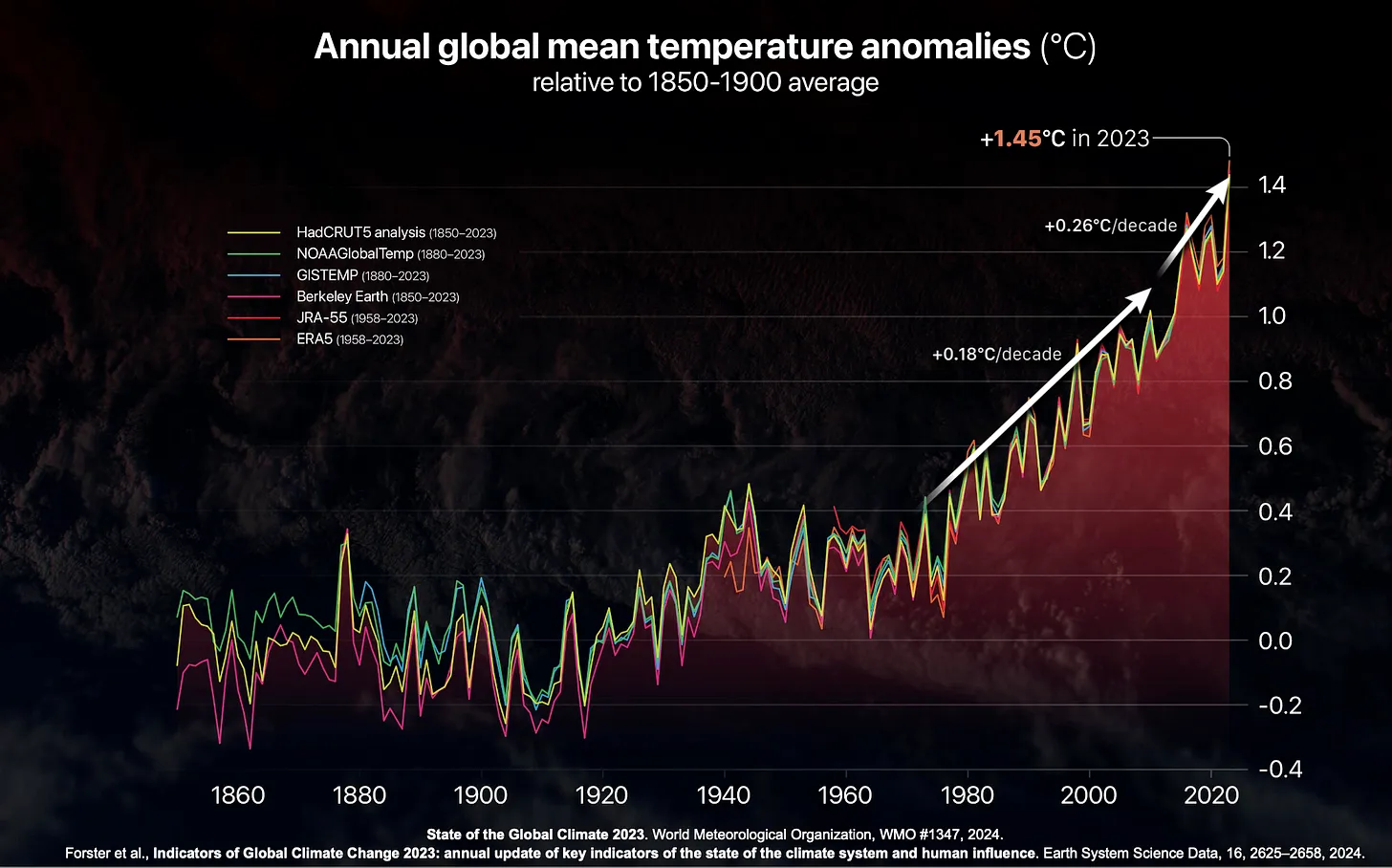
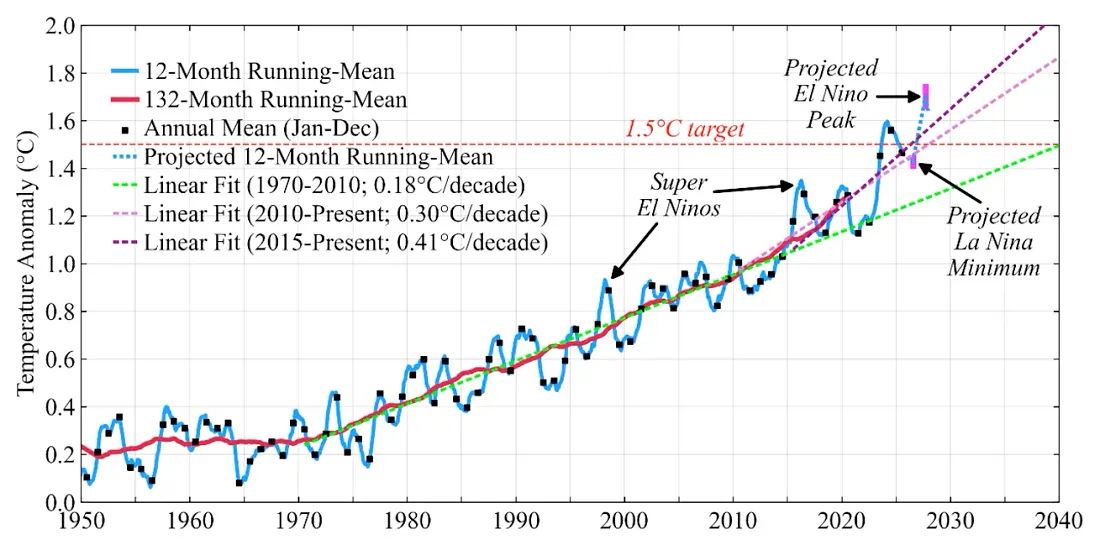
By the end of this decade, it may be heating five times faster.
Of course, the way people notice that is less through outdoor summer temperatures or early thaws in the Spring, and more through experiences of extreme weather. The different rates of warming between the equator and the poles, and over land versus over ocean, affect the air and ocean currents that once made weather predictable and now give us alternating hot and cold flashes in winter and summer alike. Warmer air holds more moisture, generating more “bomb cyclones,“ “car soups,“ and flash floods. Hotter summer waves and drier winters lead to more frequent fire conditions in forested areas. The extreme fires, floods, “snownadoes“ and “firenadoes“ draw our attention, but yo ain’t seen nuttin yet.
At 1.5°C, a marker we passed in 2024, we’ve triggered tipping elements—self-reinforcing feedback from destabilized natural balances. Polar ice melts, darkening the reflective surface, absorbing more sunlight. Dissolving permafrost and shallow clathrates releasing methane that is 20 to 80 times more effective at warming the planet than carbon dioxide from fossil fuels. Coral reefs. The Amazon rainforest. The Indian Monsoon. Australia burning. Siberia burning. Each tipping element feeds upon others, adding more to the mix, sustaining the acceleration.
A decade ago, Frank Michael and I published a detailed analysis of atmospheric and oceanic carbon drawdown using safe, reliable, natural methods of greenhouse gas removal. On land, our plan involved massive reforestation of continents—several areas the size of Spain reforested each year—with rotational harvesting and the conversion of biomass to biochar for food, fuel, energy, and a panopoly of other necessities. We imagined Ecosystem Regeneration Camps, filled with adventurous youth, planting these new forests as they sang and danced.
In the ocean, the reforestation was accomplished with kelp and sargassum, again with an annual harvest devoted to more permanent withdrawal as biochar. Still, we acknowledged, all would be for naught if we did not also solve for Jevons Paradox. Increased efficiency should not become an excuse to expand polluting activity. There needed to be simultaneous systemic degrowth. That became the subject of my most recent book, Retropopulationism.
In that book, I described one model, taken from history, that may be instructive when we set about to unsustain the unsustainable. My model was the Fox village of Saukenuk that housed around 6,000 people prior to 1830. Today, it lies under the pavement of 11th Street in the Quad Cities, Illinois, a metro area of 380,000 people.
I would have us depave 11th Street and restore Black Hawk’s village.
Black Hawk’s description of life in Saukenuk in the late 18th and early 19th centuries was the subject of my March 2019 post, Black Hawk’s 11 Percent Solution. The 11 percent figure harkens back to Frank Michaels’ calculation of the required annual degrowth rate. The glide path for industrial civilization needs to decline approximately 11 percent per year to halve production of anthropogenic greenhouse gases every 7 years for the remainder of the century. I wrote:
Most of us likely cannot conceive of how a society as complex and populous as modern techno-consumer culture could transition in a century or less to something resembling Black Hawk’s village. We take half measures, like installing renewable energy, supporting a Green New Deal or joining transition towns, which are steps along the path, but not nearly enough to get where we must go.
Brooks concluded his Harvard Radcliffe talk, saying,
I disagree. What the colonists from Europe “discovered“ was a cultivated ecology based on gift economy and pay-it-forward. They “discovered“ Saukenuk’s sustainable culture. They replaced that with something completely unsustainable. “Moral materialism“ is an oxymoron.
We must rapidly de-consumerize. We need to end our addictions to ephemera and focus on the bare essentials that we need to get by. We should all be voluntary peasants, but not in the sense of servants to some feudal lord or indebted to a bank. We need to grow our (ever-downsizing) families’ food in more challenging conditions, create walkable zones of commerce, and welcome the stranger whose own land has become uninhabitable, most often at the hands of our government.
This would be a good start, but it still won’t be enough.
We will also need extraordinary luck.
You say you’ll change the constitution
Well, you know
We all want to change your head
You tell me it’s the institution
Well, you know
You’d better free your mind instead
—The Beatles, “Revolution“
 Global Village Institute is pleased to announce that we have agreed to sponsor Biochar-On-Site.
If you would like to pledge $8 per month (about the cost of one
Peppermint Mocha or Frappuccino at Starbucks), you will make biochar
from crop and forestry waste to protect forested areas and build
healthy, water-retaining soil. The Frappuccino you buy for your friends
is now tax-deductible.
Global Village Institute is pleased to announce that we have agreed to sponsor Biochar-On-Site.
If you would like to pledge $8 per month (about the cost of one
Peppermint Mocha or Frappuccino at Starbucks), you will make biochar
from crop and forestry waste to protect forested areas and build
healthy, water-retaining soil. The Frappuccino you buy for your friends
is now tax-deductible.
Thanks for reading The Great Change! This post is public so feel free to share it.

Meanwhile, let’s end these wars. We support peace in the West Bank and Gaza and the efforts to end the war in Ukraine immediately. Global Village Institute’s Peace Thru Permaculture initiative has sponsored the Green Kibbutz network in Israel and the Marda Permaculture Farm in the West Bank for over 30 years. It will continue to do so with your assistance. We support Ukrainian families seeking refuge in ecovillages and permaculture farms along the Green Road, and we work to heal collective trauma worldwide through the Pocket Project. You can read about it on the Global Village Institute website (GVIx.org). I appreciate your support.

And speaking of resettling refugees, did you know? A study by Poland’s National Development Bank found that the influx of Ukrainians added between 0.5% and 2.5% to GDP growth and paid more in taxes than they received in benefits.
Could you help me get my blog posted every week? All Patreon donations and subscriptions to Blogger, Substack, and Medium are welcome. You are how we make this happen. Your contributions can be made to Global Village Institute, a tax-deductible 501(c)(3) charity. PowerUp! Donors on Patreon get an autographed book off each first press run. Please help if you can.
#RestorationGeneration.

We have a complete solution. We can restore whales to the ocean and bison to the plains. We can recover all the tremendous old-growth forests. We possess the knowledge and tools to rebuild savannah and wetland ecosystems. Coral reefs rebuilt with biorock build beaches faster than the seas are rising. It is not too late. All of these great works of nature are recoverable. We can have a human population sized to harmonize rather than destabilize. We can have an atmosphere that heats and cools just the right amount, is easy on our lungs and sweet to our nostrils with the scent of ten thousand flowers. All of that beckons. All of that is within reach.
 |
| We now have our own merchandise store on Redbubble. Swing on in for the latest wearables and chachkas…. |



Comments