My Grandfather Issachar’s War

We continue reading of the Shaker Museum Library’s pamphlet excerpt of the “Sketch of the Life and Experience of Issachar Bates,” published in 1960. What follows is the final of three posts in Issachar’s own words. The misspellings and grammatical errors are from the original text. He might have used more care had he imagined, 200 years ago, that he would now be blogging on Substack, Medium, Patreon and Blogger.
All of us were expecting to be relieved in 24 hours. No victuals came that day—Saturday the same—no relief—no victuals—and on Sabbath morning 8 British ships hoisted sail and came on, five up the east and three up the north river.
Each gave us a broadside as they passed the Bowery guard where we were. We gave them back the best we had 2-18 pounders which were played well—In about 2 hours the earth shook violently, and whether it was thunder or an earthquake I could not for awhile decide—But now the mystery began to open why we had not been relieved Our Army had been these two days preparing for a retreat and this morning had started, and the British were pouring in the metal upon them on both sides of the Island to cut off their retreat; but they missed their aim altogether; yet the guards were completely cut off, for the British had landed an Army on the Island who were marching down to take possession of the City & we in it
But by some means Gen. Putnam rushed thro & came and released all the guards (about 400 men) and told us to clear ourselves any way we could—A number of them pushed off an old sloop that was condemned and started acrosst the River-and were helped from the Jersey shore after she sank. For my part I took my little drummer who was about 14 years old, a pretty boy named James Ellet; we started up the North river to the Barracks to get our clothes but behold when we came on to the ground there was neither Barracks or Clothes:—they were all thrown into the river and rafted up to Kings Bridge and instead thereof a body of distressed men waiting to surrender to their enemy—Here was trouble enough and our number still increasing, small parties running back to us who had met the enemy—What is the news? Ans—we are all cut oft-and we had no commander
At length there was a colonell of some regiment, he advised us to parade rank and file and when the enemy came in sight, if we were willing he would give orders to ground our arms, and lay our hats atop of them to which we all agreed-about 200 of us & there we stood for some time
—Now I will just mention the simple means by which we escaped—By this time a number had left the ranks and took their choice to swim the river, but how they came out I know not the river was three miles wide. But while we stood here awaiting the ceremony of surrender, an Irishman stepped out and addressed the Colonell in these words “Dear Colonel-I’m thinking its no use to stand here and wait til be taken, for I’m thinking we’ll be taken fast enough to go along” Verry well replied the Colonel I will make a proposal, we will all march into yon grove* and all lie flat on our bellies; there will nothing come thro there except perhaps a small flanking party, and we will rise and fire and force our way thro” This was soon done and no flanking party came thro and we lay and heared them all march by, and then up and ran—so we attributed our deliverance to the speech of that half drunk Irishman.
*a horrid thicket
We ran about a mile & a half and it being extremely hot we made a halt on the top of a hickory nob & the first we knew we received a shower of Hot Metal from the three ships in the North River—Then we scampered down the clifts and halted no more, till we had finished our nine mile race—and came into the main road and found some of our own army
Then I took my little Drummer and went on to Kings Bridge, here we begged a slice of cold beef the first food we had tasted in 3 days—then went into a barn and slept that night—The next day (which was Monday) we found our company on Harlem Hights; nothing there to eat, and in about two hours after arrived there. The British came on and we had a heavy battle, but we drove them and kept the ground losing several of our best men
We staid but a few weeks in this place till removed back into the country—and it is out of my power to tell the various moves we made before we made a stand
For it was Gen. Washingtons policy to keep the stores & baggage always ahead on which account we were rightly named the “flying Camps” for we scarcely ever staid more than 3 days in one place; still having our stores removed we would march in the night and come up with them: then stay and guard them till they were again moved on ahead
But at White Plains the British came upon us stores and all—and there we had to fight—and a sore battle it was. But we kept our ground and defended it 3 days, long enough to get ours stores out of their reach, altho we lost a number of men—
Thus we kept on with these night marches untill we came to Croton Bridge, up the Hudson, near the Tappan Bay about 40 miles from New York—and there on the Hill made a permanent stand—
Valley Forge
Now according to the arts of war this prudent retreat is worth notice Here were all our stores and baggage covering more than an acre of ground—Hundreds of hogsheads and barrels of liquor of all kinds, Rum, Brandy, Wine, sugar, Molasses Pork Flour &c. &c-all brot out of the City of New York, and the whole underwent not less than 20 removals, with the British at our heels all the time which was for a number of weeks, and yet I do not suppose in all that time they ever got from us of these stores one single dollars worth—Here I staid untill late in the fall and my time being out I was discharged and went home with a number of others I staid at home but a short time when I enlisted under Capt. Warner and went to the Jerseys at the time of the battle of Princeton & Trenton in 1777—but the battles were fought just before we arrived, and Gen. Washington had taken 900 Hessians at Trenton and defeated the British at Princeton and they had retired to Brunswick
We were then stationed at “bound brook, where we built a fort called “Fort Staats—Here we had a number of skirmishes with the British and Hessians, but no pitched battle in front: our army paraded in the same manner, horse in Pontface to face and there they stood for near an hour, looking at each other in the face—At length our right wing let oil 2 field pieces and a heavy flank shot with rifles, and they soon sounded the trench horn for retreat, and went back to Brunswick, and we were glad to get rid of them so for they had a superior number to us but did not know it—
Now my three months were out-and I went home and in a few weeks I enlisted under Capt. Stockwell and went to Bennington and from there I went with Gen. Linckon to “Half Moon” (now Waterford) at the junction of the Mohawk with the North River—But in a short time we were sent for to return with all speed to assist at the battle of Maloomswick, but we were one day too late for the battle was fought, and Gen. Starks had taken 500 Hessians and British Regulars and 37 Tories—These were all put into Bennington Meeting House—The Tories were soon taken out and yoked together with ropes around their necks and drove off to North Hampton Jail but the rest were guarded till they were removed some time afterwards—
Saratoga
Our next call was to Saratoga to take care of the rest of Burgoynes Army—for being defeated at Stillwater was making his way back to Canada—Three regiments of us were ordered to march with all speed up the North river and take possession of Fort Edwards, to cut off his retreat (about 15 miles) This we accomplished, and kept out scouting parties in the pine woods to prevent any one escaping
In three days we received orders from Gen. Gates to return as soon as possible; for Burgoyne had capitulated, and we took a lively step you may be sure and my fife seemed to have an uncommonly joyful sound—
On our arrival, here were 5100 of our enemies soon marched off the ground under guard into Old Rutland instead of going back to Canada from whence they came. We took their ground and their arms into our possession & our regiment was soon discharged and sent home, and I with the rest for there were no more enemies in these parts to conquer.
After I got home I began to grow sick of a soldiers life and got into the notion of marrying—Tho’ I first went a short tour to Old Rutland to help guard the Burgoyne prisoners—
NOW ABOUT MY MARRIAGE AND A CHANGE IN THE COURSE OF MY LIFE
In the month of May 1778 I was married to Lovina Maynard, daughter of Barzelael Maynard of the town of Garry in which we both lived-By her I had eleven children—The first was still born, and another died a few minutes after birth; the other nine were what is called proper children— viz-Lovina, Artemas, Oliver, Nahuna, Polly, Issachar, Sarah, William and Betsy—
After I was married I bot a small farm & went to work, but I could not get rich fast enough at that & went to speculating in goods, horses, cattle, sheep-hogs and everything else a fool could think of or take a notion to
Then in 1780 there was a call for men to go to West Point for three months, and the young men would turn out if I would go—The Committee also offered me a great price if I would go, and I turned out with about 25 young men for West Point and there served out our time; altho Benedict Arnold sold us all to the British, yet the bargain was disannulled; we all returned safe home and here the war ended with me
And now whoever may read this little history of my experience in the war may have some ruminations in their mind about what kind of a soldier I was, and what for a character I supported—
A last word
Well I will candidly tell you, and you will only have my word for it—It can not consist of greatness or goodness, but this I can say in good concience that I always did my duty thro’ the war like a man—altho I was only a beardless boy—and a verry merry lively one—I never had a wry word from an officer and but verry few from a soldier thro’ the war—And I had I kind of wit that would draw the attention of every class from the Clergyman down to the Buffoon—For I could sing nearly every song that was going, whether civil, military, sacred or profane; and I could mimic almost any thing that moved; and I could make as much music on the fife as any of them
And this was not all I was as generous as the day with my messmates; for I would stand their watch tours to ease them, and often take their place in going out on scouts, and on fatigue while my only calling was to blow the fife. And what of it all? I can now say with Solomon—“This also is vanity.”
A Postscript
The American Revolution provides an interesting example of how Shakers dealt with political and cultural forces outside of their communities. They were imprisoned for declaring an unpopular opinion, yet they maintained their beliefs and did not shy away from their principles.
—Shaker Heritage Museum
In his final decade, my father (born 1907), researched our family tree but had none of the tools available to me today. I became interested in the subject when I happened to meet historian Carol Medlicott at a Communal Studies Conference in the Shaker Village of Pleasant Hill, Kentucky. I later learned that the Shaker Village had been founded by my ancestor, Issachar Bates, whose restored home, called Deacon’s House, can be rented on AirBnB.
Meeting Carol and reading her book inspired me to look more into Issachar’s life and his antecedents. Through a mix of genealogical databases, old census records, and heraldry, I am able to chart a direct line from my great-grandson, Jeremiah Bates, born in 2025, back through the Cinque Ports era of ship chandlers and customs judges, to the Battle of Hastings, the Atrebates clans of Southeastern England in the legendary era of King Arthur, legionaries in the Roman Conquest of Britain, and even the Atrebates in the Ar Valley of Belgian Gaul in the first century BCE. Alex Haley, eat your heart out. I can trace more than 100 generations of my family, and 20 of those since immigrating to North America.
That I—and my children—should spend our lives living in a utopian experimental community, The Farm, really should come as no surprise. Neither should my travels, which have taken me to more than sixty countries, preaching the gospel of peace, love, and rock n’ roll.
References:
Bates, O. (1914). Bates, et al. of Virginia and Missouri / Onward Bates, his book. HathiTrust Collection 2026-03-05, University of Illinois Urbana.
Medlicott, C. (2013). Issachar Bates: a Shaker’s journey. UPNE.
Medlicott, C. (2023). Shaker Visions of the Divine: Essays on their Sacred Art and Scripture. (PDF)
Medlicott, C. (2021). Gentle Words: The Meaning and Message of Shaker Music. Communal Societies, 41(1/2), 207-210.
Medlicott, C., & Goodwillie, C. (2012). Richard McNemar, Music, and the Western Shaker Communities: ”Branches of One Living Tree”. The Kent State University Press.
Medlicott, C. (2009). Conflict and Tribulation on the Frontier: The West Union Shakers and Their Retreat. American Communal Societies Quarterly, 3(3), 111.
Medlicott, C. (2002). Creation and the Environment: An Anabaptist Perspective on a Sustainable World. Ethics, Place & Environment, 5(3), 290-292.
Shaker Heritage Society of Albany (2011). Shakers and the American Revolution
Stein, S. J. (1992). The Shaker experience in America: A history of the United Society of Believers. Yale University Press.
Williams, J.S. (1950). Sketch of the Life and Experience of Issachar Bates. Chatham Shaker Museum.
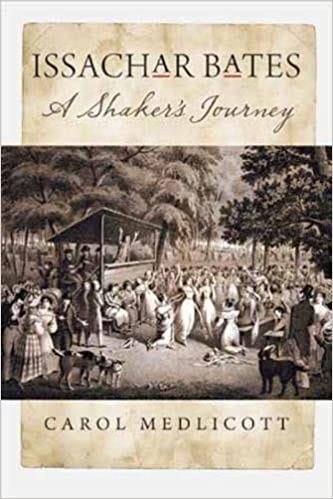
While the 1960 pamphlet I am drawing upon is a rare book, Issachar’s entire life is the subject of a larger, more comprehensive work (which also draws upon this source material) by Carol Medlicott Issachar Bates: A Shaker’s Journey (2013). Please ask your local bookstore or order online.
The Great Change is a reader-supported publication. To receive new posts and support my work, consider becoming a free or paid subscriber.

Let’s end these wars. We support peace in Iran, Lebanon, the West Bank and Gaza and the efforts to end the war in Ukraine immediately. Global Village Institute’s Peace Thru Permaculture initiative has sponsored the Green Kibbutz network in Israel and the Marda Permaculture Farm in the West Bank for over 30 years. With your assistance, it will continue.
We support Ukrainian families seeking refuge in ecovillages and permaculture farms along the Green Road, and we work to heal collective trauma worldwide through the Pocket Project. You can learn more about our work on the Global Village Institute website (GVI.cool). I appreciate your support.
Could you help me get my blog posted every week? All Patreon donations and subscriptions to Blogger, Substack, and Medium are welcome. You make this happen. Your contributions can be made to Global Village Institute, a tax-deductible 501(c)(3) charity. PowerUp! Donors on Patreon get an autographed book off each first press run. Please help if you can.
#RestorationGeneration.
 |
| Even when humans are locked in a cage, the Earth remains beautiful. So the lesson is that human beings are not necessary. The air, soil, sky and water are still beautiful without you. So, when you step out of the cage, please remember that you are guests of the Earth, not its hosts. |
We have a complete solution. We can restore whales to the ocean and bison to the plains. We can recover all the tremendous old-growth forests. We possess the knowledge and tools to rebuild savannah and wetland ecosystems. Coral reefs rebuilt with biorock build beaches faster than the seas are rising. It is not too late. All of these great works of nature are recoverable. We can have a human population sized to harmonize rather than destabilize. We can have an atmosphere that heats and cools just the right amount, is easy on our lungs and sweet to our nostrils with the scent of ten thousand flowers. All of that beckons. All of that is within reach.
 |
Thanks for reading The Great Change! This post is public so feel free to share it.


Comments