Guterres’ Climate Farewell
"There is a path to stability, but it takes courage"

Listening to Antonio Guterres’s final COP31 press conference as UN Secretary-General, I was tempted to take the Wayback Machine back to March 24, 1962, when the student demonstrations in Lisbon were gunned down by riot police, filling the hospitals with injured students and bystanders. The students were brutally put down while protesting the 30-year dictatorship of António de Oliveira Salazar and his Estado Novo fascist government.
Portugal’s March 24 Massacre was not unlike the massacre in the Plaza de las Tres Culturas in Mexico City, 6 years later, or Nixon’s Kent State massacre in 1970. Salazar responded to student protest, quite predictably, the same way Ronald Reagan reacted to the Mario Savio/Berkeley Free Speech Movement in 1964-68, urging mass arrests of those “beatniks, radicals, and filthy speech advocates.” There were administrative purges, financial pressure, and the termination of DEI programs.
When Berkeley protests flared again in May 1969 over the university’s takeover of People’s Park, then-Governor Reagan declared a state of emergency and deployed over 2,200 California National Guard troops to occupy the city. The crackdown resulted in dozens of hospitalizations, the blinding of one bystander, and the fatal shooting of student James Rector by police. For Reagan, it was a path to the White House and a hallowed position in the pantheon of Republican saints.

During Guterres’ two terms leading Portugal, recreational drug use was decriminalized, gay marriage was legalized, and Guterres himself was elevated to the presidency of the European Council. After political retirement, he was elected UN High Commissioner for Refugees, working for a decade in 126 countries, providing protection and assistance to over 60 million refugees, returnees, internally displaced people and stateless persons. He was voted United Nations Secretary-General in 2016.

In his final press conference at COP31 on November 13, Antonio Guterres lamented:
It drives hunger and displacement around the world. It wipes out development gains built over decades. It pushes countries deeper into debt. It aggravates competition for land and water. It fuels instability. And, increasingly, it threatens the very existence of communities and countries.
For all these reasons, I have never viewed climate action as just one of many other issues. Climate action is central to every aspect of the work of the United Nations. You cannot build peace on a burning planet. You cannot eradicate poverty when climate disasters keep throwing people back into it. You cannot promise young people a better future while destroying the natural systems on which that future depends. And you cannot speak seriously about justice when those who did least to cause the crisis suffer first and worst.
Fossil fuels are driving the climate crisis. There is no credible path to a safe climate without moving away from them. Here in Antalya, I have been crystal clear: We need an accelerated transition away from fossil fuels that is just, orderly and equitable. The climate demands it – but so do economics and security. Fossil-fuel dependence leaves countries exposed to price shocks, geopolitical turmoil and instability. Changing suppliers does not solve the problem. Reducing dependence does.
That means massively expanding clean energy, grids, storage, efficiency and clean electrification, while ensuring that clean-energy growth actually drives down fossil-fuel production, use and emissions. That has been my message here.
And the science has delivered another hard truth that makes all this even more imperative. An overshoot of 1.5 degrees is now inevitable. And our responsibility is to keep it as small as possible, for as short a time as possible, and bring temperatures back below 1.5 degrees as quickly as we can. But that requires immediate and drastic emissions cuts, on the order of 6 percent every year over the next few years.
Climate action must remain central to the work of the United Nations. Because this is about peace. It’s about development. It’s about human rights and justice. And ultimately, it’s about whether international cooperation can still rise to the challenges that no country can solve by itself.
I believe it can and it must. So my message as I leave Antalya is simple: Face the facts. Follow the science. Choose the future. And never give up. Thank you.
Fiona Harvey from The Guardian: Secretary General, you have been one of the most outspoken leaders on the climate crisis that we’ve ever had. Do you have any regrets?
AG: Well, first of all, I do not consider to be outspoken. I say simply what is true. What is outspoken is to say something that is not true. And if you ask me if I have any reaction, I have to say that I feel that there is. I just had a meeting with the civil society. There is growingly in the public opinion and growingly in the civil society and growingly in the commitment of several governments and institutions. A consensus that we need to do more, a consensus that we are still on a trajectory to disaster, and a consensus that what I say is, not to be outspoken, is just to tell a very simple and obvious truth.

The Six Percent Solution
Guterres’ mention of six percent was familiar territory.
Guterres’ mention of six percent was familiar territory.
When I ran the numbers some years ago for my book, Retropopulationism, I reached much the same conclusion. To have any hope of preserving Earth system stability, I estimated we would need a negative eleven percent economic (GWP) glide slope each year and, after achieving net zero near the middle of this century, thereafter to continue withdrawals of greenhouse pollutants at the same pace, banking carbon in mineral allomeres with millennial permanence, as rapidly as humanly possible.
Net zero was not the final target. It was like the sound barrier. Once there, we needed to press on. To Mach 2, 3, 4…. I wrote:

We know from many studies that energy and economies are coupled. It is possible to decouple them, but the prosperous frugal society bears little resemblance to modern consumer culture.
The Great Covid Reversal lasted one year, and then we resumed business as usual, increasing emissions to an annual growth rate of more than 2 percent per year, faster than before Covid.
By 2050, we need to be at or close to zero emissions, IPCC told the delegates at COP31. And that will not be enough. Trying to imagine this is like picturing the surprise of a pilot at the controls of a 737-MAX when his flight computer takes over and pitches the plane into an uncorrectable six-degree dive.
But then, the alternative is near-term human extinction. And here, there is room to level out before the jet craters.
35 by 35 The second week of the COP has coalesced upon one easy deliverable that, I predict, will be elevated from the aspiration agenda to the central “results” document in the closing hours. The centerpiece is Türkiye’s 35 by 35 pledge idea (it had only 30 signatories at the end of week one). 35 by 35 stands for transitioning the world to 35% electric power (as opposed to combustion engines and heating plants) by 2035. The International Energy Agency reported that it is technically feasible. Given the rapid fall in prices for solar, wind, and electric cars (thank you, China), it is not merely possible, but likely. Solar electrification is an economic no-brainer. Getting diplomats to agree to something that will happen anyway should not be a heavy lift.
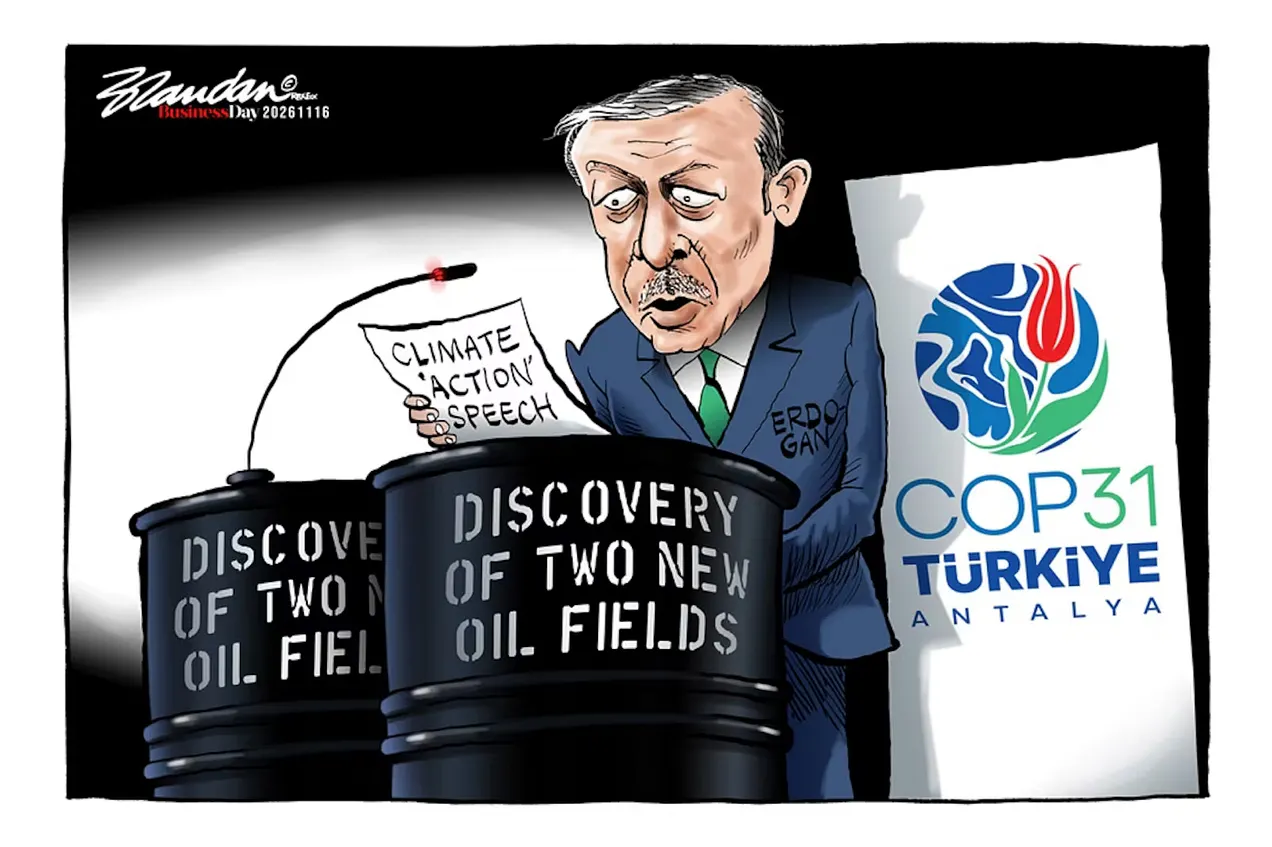
Inside the convention center, the debate has become whether electrification has to be renewable to qualify. Türkiye, which is opening scores of new coal-fired power plants, says no. Scale first, clean-up later. The Arab states and other oil producers agree. The EU27 will not push for a ‘clean’ target, says its climate chief, Mobiltotal Hoekstra: “It would be a tactical mistake to seek absolutes.” But Guterres, like most of the 100,000 people attending the COP, says it must be renewables or what’s the point? Scale first, clean-up later is what got us into this mess.
Three years ago, I wrote:
Unlike the majority of people alive today, I remember 1960. Sure, there were some nasty bits like duck and cover drills, the French nuking Algeria, Ike sending the first special forces to Vietnam, the Sharpeville Massacre, and Doris Day. But by and large, it was not all that bad, and although the world counted only 3 billion in human flesh, if we could extend that quality of life to everyone today and still be at only 9.4 GtCO2/yr emissions, we likely could scale negative emission technologies enough by 2045 to cancel that climate impact and then some.
We are confronted by the challenge of selling an unpalatable menu, knowing that what goes down easily doesn’t nourish. To sell broccoli instead of beef will require something more potent than the disruptive innovation of Madison Avenue advertising firms adopting Freudian psychology in the 1960s. It will require a whole human population effort borne of either heroism or panicked horror.
We can take the former course (heroism) now. We’ll be stuck with the latter (horror) soon enough.

Let’s end these wars. We support peace in Iran, Lebanon, the West Bank and Gaza and the efforts to end the war in Ukraine immediately. Global Village Institute’s Peace Thru Permaculture initiative has sponsored the Green Kibbutz network in Israel and the Marda Permaculture Farm in the West Bank for over 30 years. With your assistance, it will continue.
We support Ukrainian families seeking refuge in ecovillages and permaculture farms along the Green Road, and we work to heal collective trauma worldwide through the Pocket Project. You can learn more about our work on the Global Village Institute website (GVI.cool). I appreciate your support.
Could you help me get my blog posted every week? All Patreon donations and subscriptions to Blogger, Substack, and Medium are welcome. You make this happen. Your contributions can be made to Global Village Institute, a tax-deductible 501(c)(3) charity. PowerUp! Donors on Patreon get an autographed book off each first press run. Please help if you can.
#RestorationGeneration.

We have a complete solution. We can restore whales to the ocean and bison to the plains. We can recover all the tremendous old-growth forests. We possess the knowledge and tools to rebuild savannah and wetland ecosystems. Coral reefs rebuilt with biorock build beaches faster than the seas are rising. It is not too late. All of these great works of nature are recoverable. We can have a human population sized to harmonize rather than destabilize. We can have an atmosphere that heats and cools just the right amount, is easy on our lungs and sweet to our nostrils with the scent of ten thousand flowers. All of that beckons. All of that is within reach.


Thanks for reading! Everything expressed in this article is my opinion.


Comments