My Grandfather Issachar’s War

We continue reading the Shaker Museum Library’s pamphlet excerpt of the “Sketch of the Life and Experience of Issachar Bates,” published in 1960. The misspellings and grammar errors are in the original.
Firstly, I am now in the 75 year of my age; I was but a boy in those times, so that I may justly suppose that the greater part of those who were eye witnesses of these things which took place in New England “have gone the way of all the earth” and perhaps have left no account of these wonders behind them—
Secondly; I am so well acquainted with the spirit of man that I am forced to be jealous over him that even those who still survive have so little feeling to acquaint themselves with God and his wonderful works, that they either thot light of them at the time, or thro’ neggligence let the whole matter fly off with time from their minds into forgetfulness and oblivion so as to be forever hid from the knowledge of future ages—
Thirdly, because my soul has been grieved to see the goodness of God (which leadeth to repentance) not only treated with negglect, but with ridicule; for in all ages, God in his condescending goodness, whenever he was about to build up and bless a people, he gave them previous signs of his intentions; that the wise might be encouraged thereby; and whenever he was about to bring destruction on any people, he gave them warning before hand that they might be prepared to meet the event-But in these latter times if God is pleased to show any signs on earth, or wonders in heaven, the next news you will hear of the matter is, some puffed up stargazer has hoisted his telescope and reached so far into the heavens as he is able and down he comes with the pleasing news, that he can account for it all from natural causes, and the multitude mock you if you presume to contradict his divination
Now I shall return from my digression and pursue the bloody track of War; not with pleasure to my spirit, but at the request of my friends—
The Midnight Ride, Lexington Green, and the bridge at Concord
When the minute men before mentioned started for Boston, I started with them—but my Father took me back and this was a great grief to me. However in about two weeks he consented to let me enlist, which I did under Capt. Dexter, being then about 17 years and 3 months old, not old enough to pass muster in the ranks, but could pass as a fifer and I continued a fifer and fife major thro’ the war—
It was about the first of May 1775 when we took our march for old Cambridge, where the main army was collected, we being an independant company of Rangers, were stationed at the head of a marsh in open view of Boston—and the old Somerset a 70 gun ship lying in the bay between us & Boston, and often saluting us with her metal. Here I found I had got into a fix where I had no need to look for signs for I began to pertake of the substance—Nothing now remains for me but to shut my eyes, and harden my heart & enter freely into the school of vice, in which, alas!
The Seige of New York
I was not slow to learn—And untill we got well hardened, this Old Somerset troubled us verry much with repeated firing at us thro the summer-for we kept this post thro the summer—Our annoyance from the Somerset became after awhile matters of mere sport, for we would dig the balls out of the ground & take them in wheel barrows up to the College, and old Gen. Putnam would pay us for them in rum by the gallon—
Thus times went on verry well untill the 17 of June when the battle was fought at Bunker Hill. On that day we were ordered to post at the foot of the Hill, by Mystic river between Charlestown & Boston bay, and there to stand openly exposed to the Somerset, the Glasgow frigate (a moss furious instrument of war) and three floating batteries; and we had to take our full share of their hot metal—of Cannon Balls—Grape & Cannister shot—We stood where we could see all the movements of the army, and the battle on the Hill And here I saw the fulfillment of the battle of the clouds for it litterally appeared like the same thing
The Burning of Charleston
But all the horrors of this day (June 17, 1775) did not look so doleful as those of the night; for after the Hill was given up and our army had retreated, just as dark commenced the British began to burn Charleston — And Oh! what a horrible sight, to stand and behold their hot balls, carcases and stink-pots flaming thro the air for the distance of more than a mile, and in less than a half an hour that beautiful town all in flames! The smoke and the blaze, brightened the face of the whole heavens as far as we could see—And here I got the litteral fulfilment of the flaming heavens of which I saw the sign before mentioned—At the close of the Battle our army retired from Bunker Hill to Prospect Hill about ¾ of a mile distant and there began to fortify; and the British began immediately to bombard & cannonade with all their powers to prevent the progress of this new fortification, and kept it up for about 3 weeks untill the fort was finished, and then quit—
I was part of the time at these scenes, and could see them great nasty porridge pots flying thro’ the air & cramed as full of Devils as they could hold, come whispering along with its blue tail in the day time, and its firey tail by night and if it burst in the air it would thro its hellish stuff all about ones ears, and if it fell to the ground it would hop about just as if the verry Devil was in it, untill it bursted and then look out for shins and all above and at the same times cannon balls flying about once a minuit.
Now to view these wicked inventions of men to shed blood and bring destruction upon their fellow creatures, it was no wonder I was favoured with a sight of those signs & wonders which I saw in the heavens when my mind was young and tender,that after I had hardened my heart and gone thro’ the litteral fulfilment of these things that I should know how to hate them—
Now after the Fort at Prospect Hill—Fort Patterson & one at Rocksbury—a small breast work where our company were stationed, and a few other small works, there was no more forting or battles, that season except some little Skirmeshes-But in the spring of 1776 a large body of troops marched to Dorchester-I was then in Capt. Boukers company—Every plan was then contrived to drive Lord Howe out of Boston and to get both sides of him was the object and preparations were made accordingly. Thus, in the month of March one Wednesday night about 9 O’clock we took our march over Dorchester neck on to Dorchester Hill with 150 carts loaded with frames of forts, and fasheens (bundles of brush) we planted 3 forts on the Hill that night (they were not all yet filled with dirt) and as the dav began to break we left the Hill for the British to fire at; the next night went on again and did likewise—The next morning only left a guard—The next night we went on kept the Hill—and the next day which was Saturday they did their best with their cannon From every battery, firing all night and killed but four men, and we were not afraid of their landing for we had 70 barrels filled with sand, on the hill, to roll down upon them, which would have broken their ranks to shivers and they knew it—
The Sacking of Boston
On Sabbath morning about 10 Oclock they hoisted their canvass of 150 sail vessels, in our sight & cleared out— On Monday we marched into Boston & took possession of what they had left, which was of no great value; a number of starved horses, mortars also, and cannon all spiked up— The Meeting houses were gutted-the insides torn out to the ground, in order to train their light horse in them-We went to work regulating the fortifications and turning them all to our own advantage
We then marched to New York where we had another view of his excellency General Howe with his great fleet in sight again and his red coats on Staten Island—Here I was in Capt. Gates’ company, in what was called the flying camps—
Now to make a long story short; the first attack the British made was on Long Island, which they took by the sacrifice of much blood This laid the City of New York much exposed, yet every exertion was made to defend and keep it—But when this was found impossible the next plan was to clear the City of its treasures, particularly the continental stores, which was completely done out of sight of the British—Gen. Washington having ordered a large number of Batteaus to be made and put into the North River.
Retreat from New York
These boats were kept silently running every night for two weeks, from the City to Kings Bridge Nothing now remained in the City of the Continental Stores except about 50 cords of wood which was in the upper parts of the City, on what was called the “holy ground” (a large common encircled with poor wash women and also some base women).
Gen. Washington ordered a herald to mount the fence and proclaim to the poor that they might have that wood:—and here was a sight worth looking at—for in about 15 minuits, that wood was in as many divisions as there was persons, which you must know were not a few—
Now Gen. Fellows brigade to which I belonged was at this time stationed in barracks 3 miles above the city—In the latter part of August (if I mistake not) one Friday morning the guards were drawn out as usual and sent on to the City—It was my turn to fife them on & stay with them.
Next week: Issachar recounts the siege of New York; the retreats to Harlem, White Plains and Croton-on-Hudson; Washington’s retreat to Valley Forge, then Trenton and Princeton attacks; Saratoga; getting sold out by Benedict Arnold at West Point.
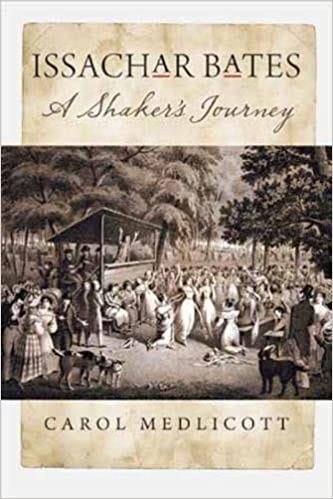
While the 1960 pamphlet I am drawing upon is a rare book, Issachar’s entire life is the subject of a larger, more comprehensive work (which also draws upon this source material) by Carol Medlicott Issachar Bates: A Shaker’s Journey (2013). Please ask your local bookstore or order online.


Comments