The Internet is Unsustainable

Writing for Communities magazine, “AI and Civilizational Collapse,” Kara Huntermoon said:
The internet is unsustainable. “Un-sustainable” means, by definition, that it cannot continue indefinitely. It will end as finite resources are exhausted.
The question she poses is whether the social infrastructure that we rely on will be so degraded as to be destroyed before then.
It is already impossible to tell, in many cases, whether a video, image, or article was created by a human being in an attempt to reflect reality, or whether it was crafted by AI.
In my own piece immediately following hers in that issue, I described how my life had been upended and thrown into turmoil by an internet stalker who expertly employed social media algorithms and fake stories to build a following. She was able to attack my reputation with an expertly crafted disinformation campaign that even sucked in many of my oldest friends.
We are now swamped by AI-supercharged disinformation at every level of society, determining who gets elected to powerful government offices and who becomes billionaires by exploiting or destroying others. Even the Pope has weighed in on the moral implications of that shift.
On our way out the door of modernity and back toward simplicity, we need to minimize the creation of new problems and re-learn nature’s elegant solutions.
—Richard Heinberg
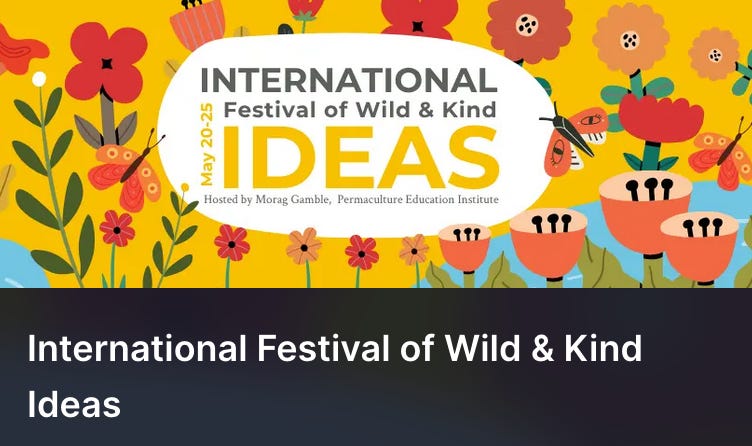
In recent weeks, Morag Gamble has been hosting her festival of Wild & Kind Ideas, an annual webinar that gives voice to several thought leaders who are largely missing from corporate media feeds. Yes, I realize this is the very internet I was just decrying, but here is perhaps a better, or even a “sustainable,” use. Every day, 4000 or more people from some 100 countries—in every different time zone—have been tuning in and drawing inspiration from Morag’s Wild & Kind Ideas. It is free. Anyone can join.
This festival provided my first encounter with Manda Scott, “a poorly focused polymath,” according to her former publicist. She was on stage with Rupert Read to discuss Thrutopianism—creating future scenarios that are healing and viable and then backcasting a path from here to there.
 |
| Manda Scott |
A few takeaways from that talk were Manda’s recollection of Donella Meadows’ 12 leverage points for social change, the second from the top being to “abandon all paradigms.” Recalling biophysics (and John Michael Greer’s Catabolic Collapse), Manda said that any system reaches maximal complexity and then it bifurcates its timeline—it either crashes into extinction or is reborn as something entirely different. The new system is completely unimaginable from the old system’s perspective. At the Global Ecovillage Network, we like the caterpillar-to-butterfly, imaginal cell metaphor.
And you use three parts of your brain and it’s quite easy cognitive work.
If I ask you what the world is going to be like 10, 15 years from now, it’s much harder cognitive work because you go into your hippocampus and you’re trying to sort through the data that you have there and you try and build a picture and then you go to your prefrontal cortex—your ventromedial prefrontal cortex—and you check: does this fit with my aims and values? And then you go to your limbic system and ask, “How do I feel about that?” And both of those work much faster than your cortex.
And the problem is that most of the stuff we’ve internalized is built around the existing system, where the narratives are of scarcity—there is not enough stuff, I have to grab stuff, you can’t have it therefore, and that’s okay. I will make that okay by inner separation: I am alone in this—and powerlessness—I individually do not have the power to make a difference.
And the system needs us to believe in that to continue. Because if we all woke up tomorrow and decided that actually there’s enough stuff and we are all together and we do have agency, the death cult of predatory capitalism would be over by tomorrow night.

If all the data center protests succeed, or governments suddenly realize that nuclear power plants, especially small modular reactors, are undisguised, easily available, high-value targets for low-cost drones, the internet and A.I. could diminish significantly as quickly as they arose. We will lose some things when we lose the internet, but we will regain the opportunity to build closer, more real connections with people we can actually hug. We won’t require climate-destroying pets nearly as much.
Huntermoon writes:
There is actual proof that we can do this, and some of it is still in living memory, including my own.
In that vein, Donnie Deutsch, the advertising brand guru, says that in the podcast world, geezers like him and me are outpolling younger influencers by large margins. Go figure. People seem to want to get their actionable information from more reliable sources—those with a track record for truth and accurate forecasting. They are turning to Brand Up sites like The Great Change.
Thanks for reading The Great Change! This post is public so feel free to share it.

Meanwhile, let’s end these wars. We support peace in Iran, Lebanon, the West Bank and Gaza and the efforts to end the war in Ukraine immediately. Global Village Institute’s Peace Thru Permaculture initiative has sponsored the Green Kibbutz network in Israel and the Marda Permaculture Farm in the West Bank for over 30 years. It will continue to do so with your assistance. We have a pipeline to aid in the West Bank that may only last a short time, so we appreciate immediate donations—right now.
We support Ukrainian families seeking refuge in ecovillages and permaculture farms along the Green Road, and we work to heal collective trauma worldwide through the Pocket Project. You can read about it on the Global Village Institute website (GVIx.org). I appreciate your support.
Could you help me get my blog posted every week? All Patreon donations and subscriptions to Blogger, Substack, and Medium are welcome. You are how we make this happen. Your contributions can be made to Global Village Institute, a tax-deductible 501(c)(3) charity. PowerUp! Donors on Patreon get an autographed book off each first press run. Please help if you can.
#RestorationGeneration.

We have a complete solution. We can restore whales to the ocean and bison to the plains. We can recover all the tremendous old-growth forests. We possess the knowledge and tools to rebuild savannah and wetland ecosystems. Coral reefs rebuilt with biorock build beaches faster than the seas are rising. It is not too late. All of these great works of nature are recoverable. We can have a human population sized to harmonize rather than destabilize. We can have an atmosphere that heats and cools just the right amount, is easy on our lungs and sweet to our nostrils with the scent of ten thousand flowers. All of that beckons. All of that is within reach.




Comments